 English
 عربى
 Français
 русский
 Español
 中文简体
If you have ever looked at the nameplate on the back of a commercial refrigerator and seen something like "5-15P" printed next to the voltage, you have already met one of the most common electrical connectors in North America. The short search term "5 15 plug" almost always points to the same thing: a NEMA 5-15 plug, the three-prong, 125-volt, 15-amp connector that powers everything from a countertop appliance to a two-door stainless steel chiller.
For a restaurant owner, a kitchen project manager, or an importer putting together a cold-chain package, this small piece of hardware is far from trivia. It decides whether the equipment you just bought can be plugged in on day one, or whether it needs a new receptacle, a different circuit, or an electrician on site. What follows is a plain-language explanation of the NEMA 5-15, how it differs from the plugs around it, and what to check before you commit to a refrigeration purchase.
What a NEMA 5-15 Plug Actually Is
The name is a code, and every part of it means something specific. NEMA stands for the National Electrical Manufacturers Association, the body that writes the configuration standards for North American plugs and receptacles. Once you know how to read the code, a whole family of connectors becomes easy to sort out.
- 5 identifies the blade arrangement and voltage class: two poles, three wires (hot, neutral and ground), rated for 125 volts nominal.
- 15 is the maximum current the configuration is rated to carry: 15 amperes.
- P means plug and R means receptacle. A 5-15P is the male cord end, while a 5-15R is the wall outlet it fits into.
Physically, the plug is simple. Two flat parallel blades carry the hot and neutral conductors, and a round grounding pin sits below them. That third pin is the reason a NEMA 5-15 is often called a grounding plug, and it is why the connector is described as a three-wire device. The grounding path gives the appliance chassis a safe route for fault current, which matters a great deal on equipment that runs a compressor motor for hours at a time in a busy kitchen.
In North America the supply behind a 5-15 receptacle is normally 60 Hz alternating current. The 15-amp rating is the ceiling for the connector itself, not a promise that the circuit behind it can deliver that much continuously, so the breaker and the wiring always deserve a look before you assume the outlet is ready for a new unit.
NEMA 5-15 Compared With Other Plugs You Will Meet
Most confusion around the 5-15 plug comes from mixing it up with its neighbours. The table below puts the common North American configurations side by side, which is often all it takes to recognise the connector on your equipment.
| Configuration | Voltage | Maximum current | Grounding pin | Where you usually see it |
|---|---|---|---|---|
| NEMA 1-15 | 125 V | 15 A | No | Small appliances and older lighting |
| NEMA 5-15 | 125 V | 15 A | Yes | Display chillers, counter refrigerators, upright cabinets |
| NEMA 5-20 | 125 V | 20 A | Yes | Larger kitchen equipment on 20 A circuits |
| NEMA 6-15 | 250 V | 15 A | Yes | Equipment wired for 208-240 V supplies |
Two details trip people up. First, a NEMA 5-20 plug is not interchangeable with a 5-15 receptacle: the 20-amp version has a differently shaped neutral blade so it physically will not enter a 15-amp outlet. Second, plugs used in export markets are a separate story entirely, because a 220-240 V, 50 Hz unit will be fitted with the connector appropriate to its destination rather than a NEMA 5-15.
Why the Plug Matters on Commercial Refrigeration
Refrigeration equipment is a motor load, and motor loads behave differently from a lamp or a toaster. A compressor draws a steady running current while it is cooling, but on start-up it briefly pulls several times that amount as the motor accelerates. A 15-amp branch circuit gives a moderately sized cabinet enough headroom for that inrush without nuisance tripping.
That is why the plug choice is really a circuit conversation. A single-door glass door display chiller might only draw a few amps while running, while a four-door upright freezer or a blast freezer pulls considerably more and may need a 20-amp circuit or even a dedicated feed. The nameplate, not the plug alone, tells you what the unit expects.
 Two-Door Stainless Steel Glass Door Display Refrigerator RE SeriesCommercial RE-series display refrigerator with 900 L capacity, two heated glass doors, and chiller or freezer temperature options; check its nameplate before circuit planning.View Product →
Fitting Your Equipment to a 15-Amp Circuit
There is a widely used rule of thumb for continuous loads: keep them at or below 80 percent of the circuit rating. On a 15-amp circuit that works out to roughly 12 amps of continuous draw, with the remaining capacity reserved for start-up surge and for the fact that other appliances may share the same circuit.
In practice, this means a few sensible habits pay off in a commercial kitchen:
- Give refrigeration equipment its own circuit wherever the layout allows, rather than sharing with fryers, kettles or coffee machines.
- Check the receptacle location against the cord length so you never need an extension lead, which is a poor long-term solution for a compressor load.
- Allow for wet-location protection. Receptacles close to sinks, prep areas and wash-down zones are typically required to have ground-fault protection in many jurisdictions.
- Plan for the start-up surge rather than the running amps alone, especially when a freezer cycles on beside other motor-driven equipment.
When several cabinets are involved, the arithmetic is straightforward: add the running currents, leave room for inrush, and split the load across more than one circuit if the total creeps toward the limit. A qualified electrician can confirm the answer in minutes, and it is far cheaper than discovering the problem after the equipment is already on site.
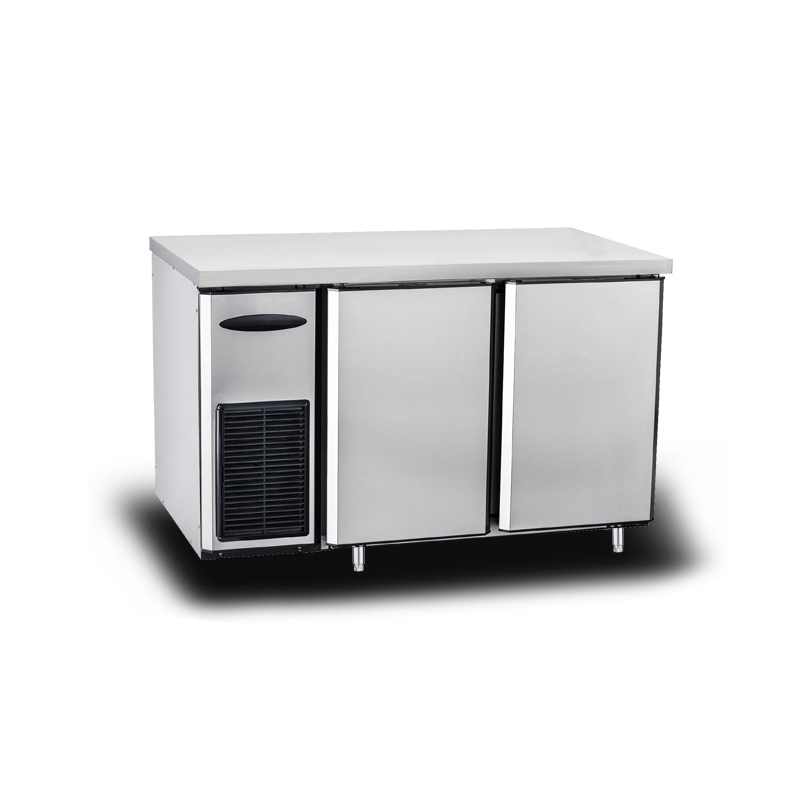 1200mm Two-Door EK Series Stainless Steel Undercounter RefrigeratorCommercial EK-series counter refrigerator with adjustable shelves and 220–240V or 100–110V options; useful when confirming cabinet current loads before installation.View Product →
What We Check Before a Unit Leaves the Factory
Redbowl has been building commercial refrigeration equipment since 1987, and our production site in Shengzhou, Zhejiang has been running since 2008, about an hour from Ningbo port. Over that time a predictable pattern has emerged: electrical mismatches cause more installation delays than any mechanical issue, and almost all of them are avoidable at the ordering stage.
Before a cabinet ships, the destination market decides the cord set. Units headed to North America are configured for 120 V, 60 Hz supplies and a NEMA 5-15 plug, provided the model's electrical load suits a 15-amp circuit. Units for Europe, the Middle East or South America are configured for their local voltage, frequency and connector instead. Buyers who tell us the country, the supply voltage and the available circuit at the point of installation get a unit that plugs straight in.
If you would like to see how the range is organised, our factory and production profile covers where the equipment is built, and the product catalogue download lists model-level specification data you can share with your electrician before delivery day.
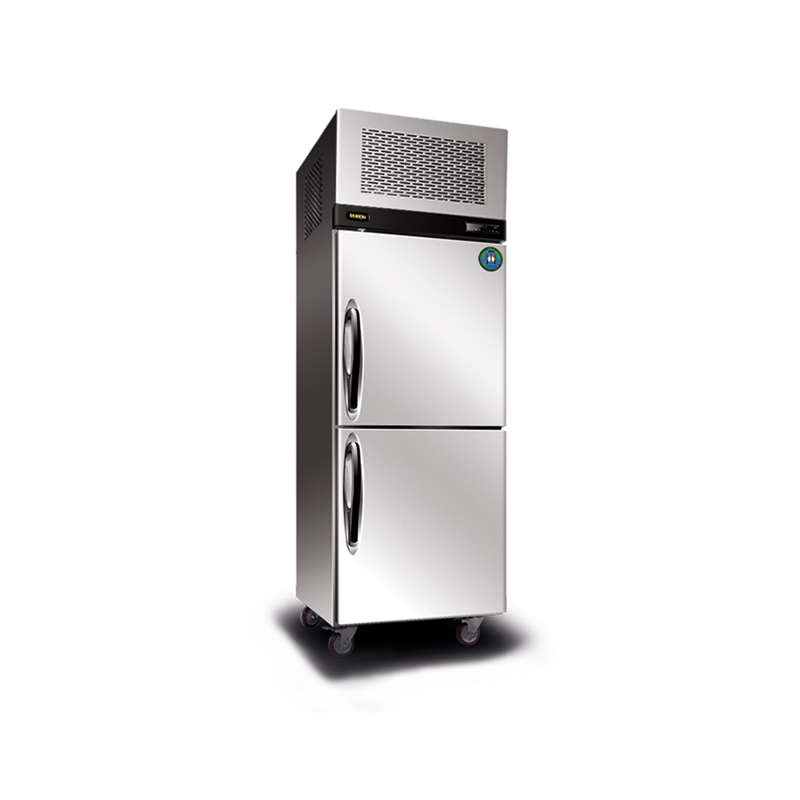 UA-680BF Two-Door Stainless Steel Blast FreezerCommercial blast freezer with 350 L capacity, -35°C operation, and 220V/380V options; suitable for central kitchens, food factories, and ice cream shops.View Product →
A Short Pre-Order Checklist
Whether you are buying one counter refrigerator or fitting out a whole kitchen line, these steps remove nearly every plug-related surprise.
- Read the nameplate for rated voltage, frequency and running current.
- Confirm the amperage of the circuit you intend to use, and whether it is shared.
- Identify the receptacle type already installed and check it matches the plug on the unit.
- Verify grounding and any ground-fault protection required in the installation area.
- Leave headroom for compressor start-up surge rather than planning to the running figure.
- Tell your supplier the destination country and supply characteristics at the quotation stage.
Questions We Hear Most About the 5-15 Plug
Is a NEMA 5-15 the same as a Type B plug?
Yes, in North American terms. The Type B description refers to a three-prong grounded plug rated for 15 amps at 125 volts, which is the NEMA 5-15 configuration. The Type A plug, by contrast, is the older two-blade ungrounded design.
Will a commercial refrigerator run on a 15-amp circuit?
Usually yes for single-door and moderately sized two-door cabinets, as long as the circuit is not heavily shared. Larger multi-door cabinets and blast freezers often need a 20-amp circuit, so the nameplate current is the number that settles the question.
Can I swap a 5-15 plug for a 5-20 plug?
Only when the circuit, wiring and receptacle are all rated for 20 amps. Fitting a 20-amp plug to equipment without changing the circuit creates a mismatch and may void compliance with local electrical codes. Rewiring should always be done by a qualified electrician.
Is the NEMA 5-15 connector waterproof?
No. The configuration itself is not sealed, so wet or outdoor locations need appropriate covers, enclosures and ground-fault protection rather than relying on the plug.
Does the plug type affect cooling performance?
Not directly. The plug simply has to match the supply it is connected to. Cooling capacity, temperature pull-down and energy use are determined by the compressor, evaporator, condenser and insulation of the cabinet rather than by the connector on the cord.
The NEMA 5-15 is a modest piece of hardware that carries a great deal of practical weight. Once you can read the code, check the nameplate and match the load to the circuit, the electrical side of a refrigeration purchase stops being a source of stress and becomes one more detail you have already handled. If you are unsure which configuration suits a particular model or market, ask before the order is placed, and the unit will arrive ready to run.