 English
 عربى
 Français
 русский
 Español
 中文简体
Ask anyone who has spent years on a busy kitchen line and they will tell you the same thing: the number glowing on the controller is not always the number that matters. Refrigeration temperature control is really about keeping the product itself — the milk, the raw chicken, the portioned dough — inside a safe range from delivery to service. Everything else, from the thermostat to the condenser coil outside the back door, exists to serve that single goal.
We have been building commercial refrigeration equipment since 1987, starting in Taiwan and, since 2008, at our factory in Shengzhou, Zhejiang. Over that time we have noticed that temperature problems are seldom mysterious. They come from a short list of ordinary causes, and they are usually inexpensive to fix once you know where to look.
Three Temperatures Sit Inside Every Refrigerator
When someone says a cabinet is "running at 3 degrees", they could mean three different things, and the difference matters during an inspection.
- Set point: the value entered into the controller. It is a target, not a measurement.
- Air temperature: what the cabinet probe reads as return air passes over it — the number most displays show.
- Product temperature: the core temperature of the food itself. This is the one that decides whether food is safe.
A cabinet can hold steady air at 2 °C while a crate of warm milk inside it takes three or four hours to reach that level. That gap is why food safety rules are written around the product rather than the display, and why a working probe thermometer belongs in every kitchen.
What Decides How Steady the Temperature Will Be
Four parts of a refrigeration system do most of the work in holding a set point. Weakness in any one of them shows up as drift, short cycling, or a cabinet that runs continuously without ever quite catching up.
The Sensor and the Controller
Electronic controllers are far more precise than the mechanical thermostats of thirty years ago, but they are only as good as the probe they read. A probe pushed too close to the evaporator reads cold air and shuts the compressor down early; a probe near the door reads warm air and runs it too long. Ice build-up does the same thing. Check the offset once or twice a year against an ice bath or a calibrated reference — a two or three degree error is easy to introduce and easy to miss.
Airflow Inside the Cabinet
Forced-air cabinets cool by moving cold air across the shelves, so anything blocking the return path creates warm pockets. Overfilled shelves, trays pressed flat against the back wall, boxes stacked against the evaporator cover — all raise product temperature while the display still looks fine. Leave a hand's width at the rear and above the top shelf, and treat a nearly empty cabinet as a problem rather than a bonus: it cycles more and holds temperature less evenly than a full one.
Heat Rejection at the Condenser
A refrigerator does not create cold; it moves heat from inside the cabinet to somewhere else. In an air-cooled condenser, that heat leaves through the coil and fan. When the coil is dusty, bent, or starved of air, pressures rise and the cabinet struggles to hold its set point. Cleaning the condenser monthly in a greasy kitchen is one of the highest-return maintenance tasks there is. A generously sized coil also gives useful headroom on a hot day, which is exactly what our stainless steel SCON series air-cooled condensers are built for.
 SCON510 Stainless Steel Air-Cooled Condenser SeriesStainless steel air-cooled condenser with corrosion-resistant materials, large-diameter fans, and multiple row/fan configurations; suited to refrigeration cooling systems needing reliable heat removal.View Product →
Doors, Gaskets and Defrost
Every door opening gives away cold the cabinet has already paid for. Gaskets gone hard or torn, hinges that no longer hold the door square, and missing auto-closers all quietly raise running hours. Defrost is the other half: the coil must be cleared of frost on schedule, or airflow collapses and temperatures climb. If a cabinet runs well in the morning and wanders by mid-afternoon, look at the defrost settings before suspecting the refrigerant charge.
Holding Temperatures Worth Aiming For
These are the ranges we most often see specified for commercial kitchens and food retail. They are a starting point, not a substitute for your local regulations.
| Product group | Target holding temperature | Equipment typically used |
|---|---|---|
| Chilled ready-to-eat food, dairy, deli | 0 to 4 °C (32 to 39 °F) | Upright chiller, counter refrigerator |
| Raw meat and poultry | 0 to 2 °C (32 to 36 °F) | Upright chiller, GN pan cabinet |
| Salads, cut vegetables, dressings | 2 to 5 °C (36 to 41 °F) | Salad counter, display chiller |
| Milk, soft drinks, beer | 2 to 5 °C (36 to 41 °F) | Glass door display chiller, bar counter |
| Frozen storage | -18 °C (0 °F) or colder | Upright freezer, display freezer |
| Ice cream | -20 to -22 °C (-4 to -8 °F) | Display freezer |
| Blast freezing | -30 to -40 °C air, core to -18 °C | Blast freezer |
When the Temperature Drifts: A Short Checklist
Before calling an engineer, walk through these points. In our experience they explain the large majority of "the fridge is not holding temperature" reports.
- Warm or bulky product loaded in the last few hours, especially anything still steaming.
- Shelves packed so tightly that return air cannot reach the evaporator.
- A condenser coil that has not been cleaned since the last service visit.
- A gasket that fails the paper test — close the door on a sheet of paper and pull; it should resist.
- A iced or badly placed probe feeding the controller false information.
- A defrost cycle that is too short, too long, or timed for the busiest hour of service.
If none of these explain the drift, the issue is likely refrigerant-related and belongs with a qualified technician.
Commissioning a New Cabinet Properly
Most first-month complaints come down to commissioning rather than the equipment itself.
- Check the clearance around the condenser before anything else is switched on.
- Run the cabinet empty until it holds its set point — often four to six hours in a hot room.
- Load in stages, never bringing in product warmer than the cabinet is designed to absorb.
- Verify with an independent probe placed in the product, not just the display.
- Record the set point and defrost schedule, then show the team what the alarm means.
Rapid Freezing Is a Different Job
Blast freezing pushes temperature control into a much wider range. Air inside a blast freezer typically runs at -30 to -40 °C so the core of the food crosses the ice-crystal formation zone quickly, which protects texture and reduces drip loss. A storage freezer cannot do this — its coil and airflow are sized for holding, not for pulling heat out of a heavy batch of warm product. Tray spacing matters even more here, because trays pressed together freeze on the outside while the middle stays soft.
 UA-680BF Two-Door Stainless Steel Blast FreezerCommercial two-door blast freezer with -35°C range, Maneurop system, 350 L capacity, and GN pan compatibility, suited to rapid freezing in central kitchens.View Product →
Matching Equipment to the Temperature You Need
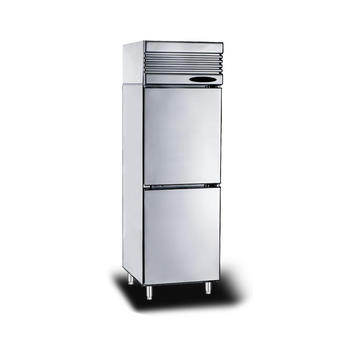
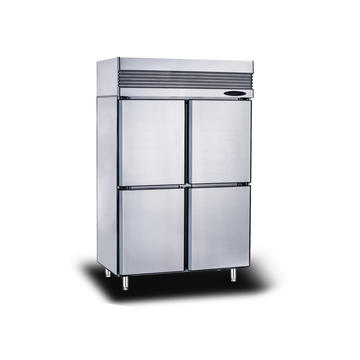
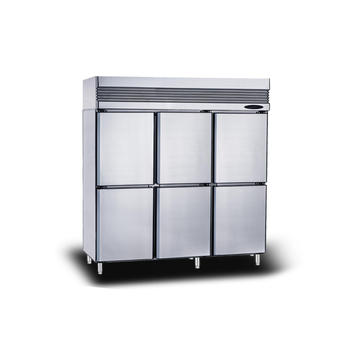
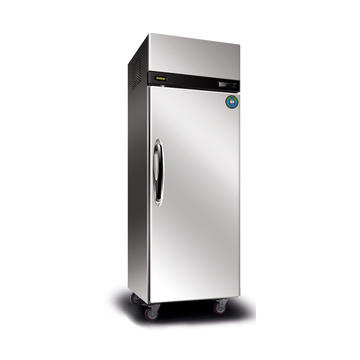
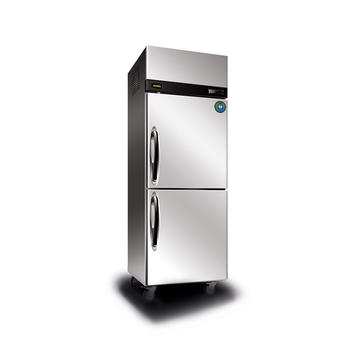
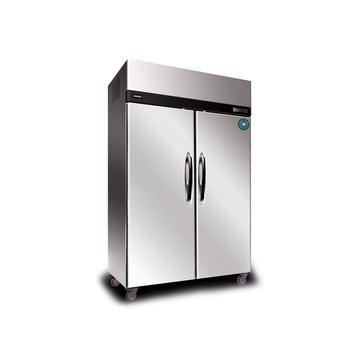
Once the target range is clear, choosing equipment becomes simpler. Display cabinets, storage cabinets and preparation counters all control temperature differently because they are used differently. A glass door display chiller fights radiant heat and constant door openings; a counter refrigerator has to survive being a work surface as well as a cold store. Upright stainless steel refrigerators, for their part, are chosen for volume and hygiene, with half-height doors that let staff open only the section they need — a small detail that makes a measurable difference to how often the compressor starts. Our upright stainless steel refrigerators are built around that idea, with the RL/RS, RA and UB series covering different door counts and heights.
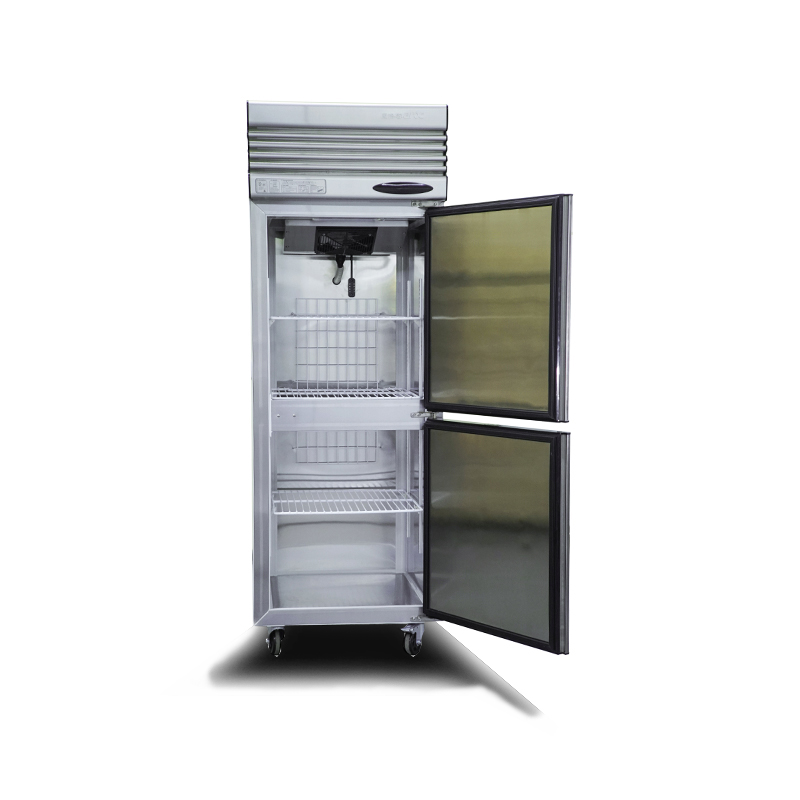 RL/RS Series Upright Stainless Steel Half-Door ChillerRL-680C / RS-680F stainless steel upright half-door chiller/freezer with 470 L capacity, digital controller, auto-close door, and easy-maintenance cooling unit for volume and hygiene.View Product →
Good refrigeration temperature control is rarely about one clever feature. It is the sum of a sensible set point, a clean condenser, unobstructed airflow, sound door seals, and staff who understand what the display is telling them. Get those five things right and most cabinets will run quietly for years.
Redbowl has been building commercial refrigerators, freezers, evaporators and condensers since 1987, with manufacturing in Shengzhou, Zhejiang and an office in Taiwan. If you are specifying equipment for a kitchen, a retail floor or a cold chain project, you are welcome to browse our product catalogue or tell us the temperature range you need to hold — we are happy to talk it through.